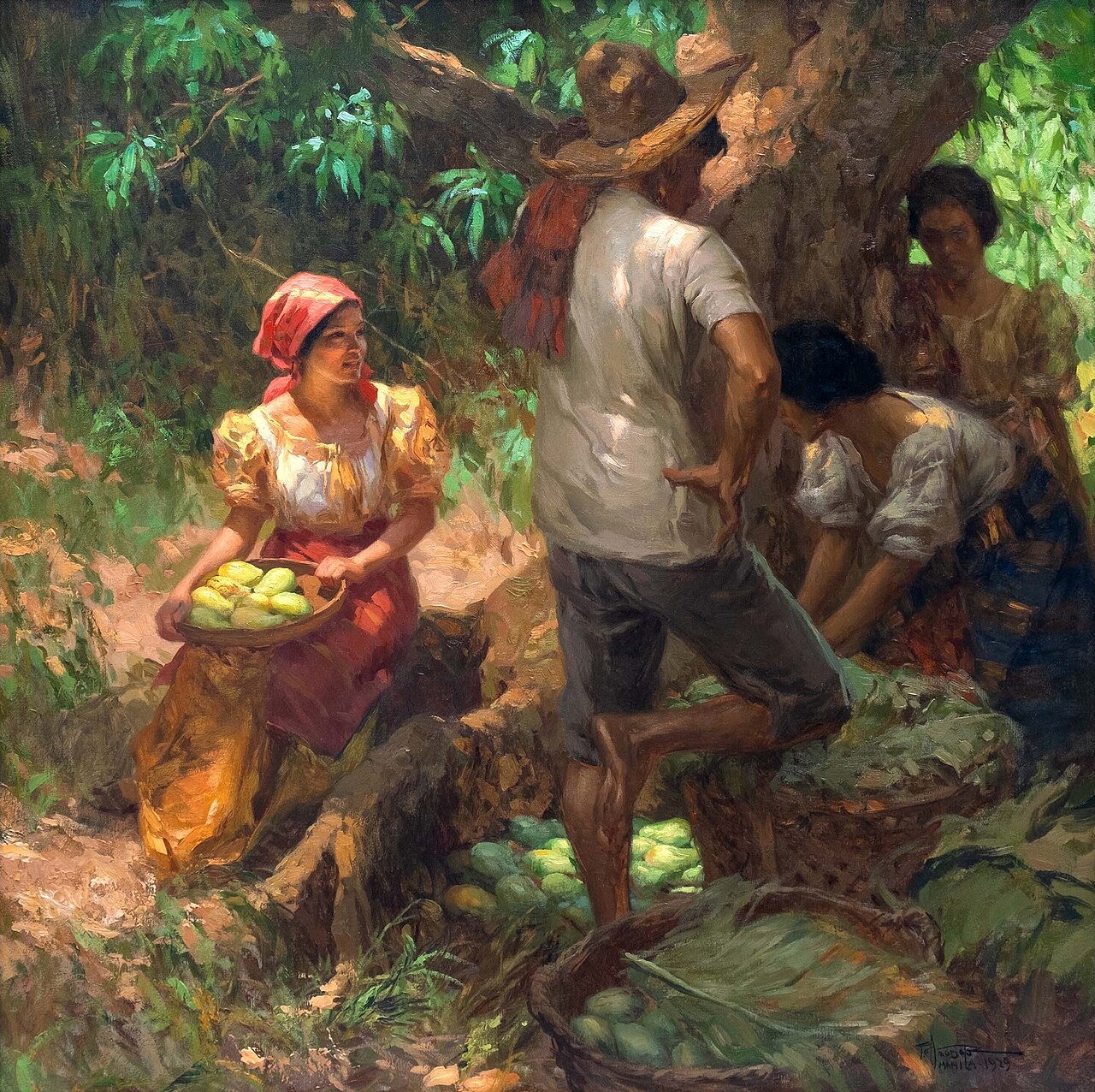
Fernando Amorsolo painted Philippine sunlight: rice fields, dappled under mango trees, women in baro't saya, and wartime ruins remembered in oil. He became the country's first National Artist for Painting (1972) and set a popular visual memory of rural beauty.
Life and work
Dates: 1892-1972. Place: Manila and rural Luzon subjects; Philippines. Medium: Oil painting; luminous genre and landscape.
Born in 1892 in Paco, Manila (raised partly in Daet, Camarines Norte), Amorsolo studied at the University of the Philippines School of Fine Arts and briefly in Spain. He worked as an illustrator and painter in Manila, developing a trademark backlit figure style. During World War II he painted occupation-era subjects alongside pastoral scenes. He died in 1972 in Manila. Public honors and museum retrospectives in the Philippines are well documented. Amorsolo's commercial illustration work sharpened his speed and clarity under deadline, skills that fed his oil production. Postwar demand for reassuring rural images sometimes conflicted with memories of occupation violence he also painted. Amorsolo's skies are active characters: late afternoon gold, monsoon grey, harvest clarity. He painted the Philippines as desirable at a time when colonial and postwar politics made desire complicated. Understanding his popularity is part of understanding twentieth-century Philippine visual culture at home and abroad.
Signature works
Planting Rice, countless variations of river washing scenes, fiestas, and portraits form the public corpus. Wartime paintings of destruction also belong to the documented oeuvre. Works are held by the National Museum of the Philippines, Lopez Museum, and many private collections.
Who they inspired
Amorsolo shaped mid-century Philippine genre painting and commercial calendar art. Later artists either continued his luminous pastoral or reacted against it as nostalgic. Filipino-American home aesthetics often circulate Amorsolo reproductions as heritage images. Calendar publishers and Sunday painters followed his backlight formula. Modernist and social-realist Filipino artists defined themselves partly by refusing his sweetness, which still proves his gravitational pull.
American / US crossover
Real US crossover runs through Filipino-American households, community exhibitions, and US museum acquisitions of Philippine modern art. Amorsolo visited and showed in contexts tied to American colonial and postcolonial circuits; the densest American fan base is diaspora memory rather than a New York school narrative. We do not invent specific US gallery ownership for Orchid Way. In California, Hawaii, and other Filipino-American hubs, Amorsolo prints hang in living rooms as heritage anchors. US museums collecting Philippine modernism increasingly contextualize him beside harder wartime and urban subjects.
Era door: After the nation