
Beijing, December 2017
One hundred and forty million dollars
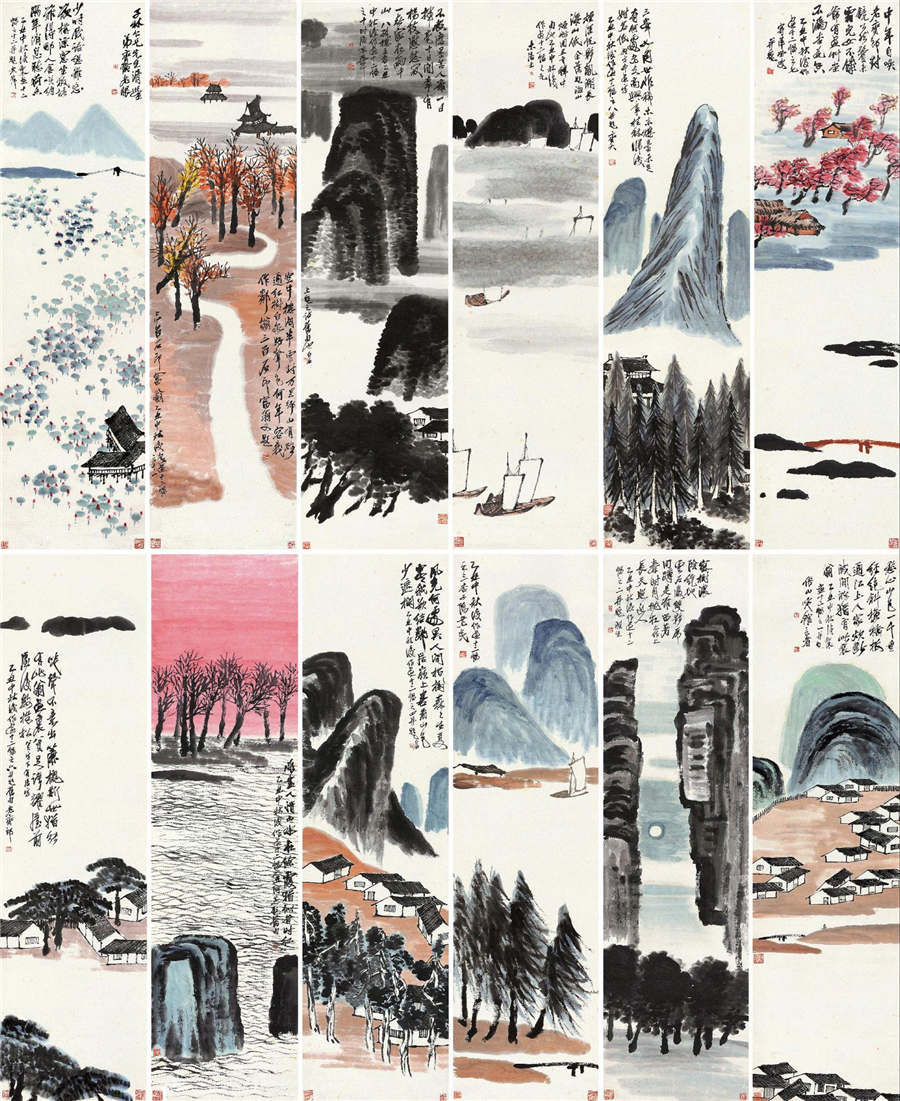
In 1925 Qi Baishi painted twelve landscapes as a birthday gift for a friend, a Beijing physician named Chen Zilin. Villages, rivers, and mountains move through the seasons, each panel carved with his seals and written with a poem.
Ninety-two years later the twelve screens came to auction at Poly Auction in Beijing and sold for US$140.8 million, the highest price ever paid for a painting by an Asian artist. Today they belong to a private collector, and very few people will ever stand in front of them.
Imagine
A masterpiece held by many hands
Imagine the Collective in the saleroom in Hong Kong, bidding on a work like this together. Not one buyer, but a circle of collectors who love the same painting and share in owning it.
Now imagine where it goes next. Not into a vault. Onto the walls of the Louvre, the Palace Museum, the National Museum of Korea, with the story of the people who brought it there written beside it.
That is the idea behind Shared Owners: that the greatest works of Asian art can be acquired, cared for, and shown by a community, rather than disappear into a single private room.
The top of the room
Where these works are sold
Zhang Daqian’s Landscape after Wang Ximeng became the most valuable Chinese painting ever sold at Sotheby’s. Works of this rank change hands a few times in a generation, in a handful of rooms, and almost always to a single buyer.
View as table
| Work | Maker and period | Result |
|---|---|---|
| Twelve Landscape Screens | Qi Baishi, 1925 | $140.8M, Poly Auction Beijing, 2017 |
| Twelve Views of Landscape | Wang Meng, Yuan dynasty | About $62M, Poly Auction Beijing, 2011 |
| Six Dragons | Chen Rong, Song dynasty | $48.9M, Christie’s New York, 2017 |
| Chicken Cup | Chenghua reign, Ming dynasty | $36.0M, Sotheby’s Hong Kong, 2014 |
| My Lonely Cowboy | Takashi Murakami, 1998 | $15.2M, Sotheby’s New York, 2008 |
| Untitled (Nets) | Yayoi Kusama, 1959 | $10.5M, Christie’s New York, 2022 |
How it would work
Four steps from saleroom to museum wall
- Scholars choose the work.Authenticity, title, and significance are established by curators before anything else is discussed.
- The work is acquired and held in its own entity.The painting is never divided. Ownership of the entity that holds it is.
- Collectors share in owning it.Each shared owner holds an interest in that entity, alongside others who care about the same work.
- The work is cared for and shown.Conserved, insured, and lent to museums and exhibitions, so that it is seen.
For the curious
Understanding shared ownership
Shared, or fractional, ownership of art already exists. None of it has been built around the art of Asia. Open any of the three sections below for a fuller explanation.
The basics
The idea in one sentence
Instead of one person owning a whole artwork, many people each own a small piece of the thing that owns it.
It is older than it sounds
Dealers have long bought expensive works together and split the proceeds when they sell. Museums sometimes acquire a major work jointly and share it between them. Online platforms took that old practice and opened it to many more people.
How a typical platform works, in six steps
- A work is acquired. The platform buys a painting, or agrees terms with its owner.
- The work is placed in its own company. Each work usually sits inside a separate legal entity created just for it.
- That company is divided into interests. Think of it as slicing the company, not the canvas.
- People buy interests. Each interest is a small share of the company that owns the work.
- The work is stored, insured, and sometimes lent. It does not hang in anyone’s living room.
- Eventually the work is sold. The proceeds, after costs and fees, are divided among the interest holders.
What you actually own
An interest in a company. You do not own a corner of the painting, you cannot visit it at will, and you do not decide when it is sold.
Words to know
| Interest or share | Your slice of the company that holds the work. |
|---|---|
| Custodian | Whoever physically holds and cares for the work. |
| Holding period | How long the work is kept before it is sold. |
| Liquidity | How easily you can turn your interest back into cash. |
| Provenance | The documented history of who has owned a work. |
Going deeper
Four structures in use today
| Model | How it works | Example |
|---|---|---|
| One company per work, registered offering | Each work sits in its own series company. Interests are sold under a securities exemption the regulator has reviewed. | Masterworks (United States) |
| Shares listed on a regulated exchange | A work is floated like a company in an initial offering, then its shares trade on a licensed venue. | Artex (Liechtenstein) |
| Direct co-ownership | Buyers hold a legal co-ownership share of the physical object, with an escrow agent representing the co-owners. | Splint Invest (Switzerland) |
| Tokenisation | Ownership is recorded as digital tokens on a distributed ledger. | Particle and others |
Why regulation applies
In the United States, selling interests in an artwork to the public is usually selling a security. Buyers put in money, expect a profit, and rely on someone else’s work to earn it. That is the core of the long-standing Howey test. Platforms therefore use a securities route:
- Regulation A, Tier 2: a lighter public offering reviewed by the SEC, open to non-accredited buyers within limits. Masterworks uses this, with each painting in its own entity.
- Regulation D: private placements, generally limited to accredited buyers.
- Outside the United States: Artex operates as a regulated trading venue in Liechtenstein, while Splint Invest operates under Swiss rules.
How platforms are paid
Fees come in several layers, and most platforms use more than one:
- Sourcing spread: the difference between what the work cost and the capital raised.
- Annual management fee: Masterworks discloses 1.5 percent a year.
- Profit share: Masterworks takes 20 percent of any gain on sale.
- Listing and trading fees: Artex has reported a 3 percent listing fee and a small fee on each trade.
Care of the object
Every model has to answer the same questions: where the work is stored, who insures it, who can lend it to a museum, and who values it between purchase and sale.
Getting out
- Wait for the sale. Masterworks has said it aims to hold works for three to ten years.
- Sell to another buyer. Some platforms run a secondary market where interests change hands before the work is sold.
- Takeover bids. Artex allows a bid for a whole work above a set threshold, which triggers an auction.
The main risks, plainly
- Interests can be hard to sell.
- Fees reduce what reaches the owner of the interest.
- Values between purchase and sale are estimates, not prices.
- One work is a concentrated position.
- If the platform itself fails, the structure around the work matters a great deal.
The hard problems
1. Conflicts of interest
On many platforms, one company chooses the work, buys it, sets the offering price, manages it, and decides when to sell it. Analysts reviewing public filings have asked how much of the money raised actually reaches the artwork. AltStreet, for example, estimated that across 130 Masterworks offerings, art at cost averaged about 89 percent of the capital raised. A credible structure separates judgement about the work from the economics of the offering, and says so in writing.
2. Secondary markets are regulated activity
Matching buyers and sellers is not a casual feature. In July 2023 the SEC settled charges against RSE Markets, the operator of Rally, for running an unregistered securities exchange through its trading windows, with a $350,000 penalty. Masterworks’ secondary trading has run through an alternative trading system operated by North Capital. Its 2026 filings disclose that the arrangement is ending, with no assurance that a comparable mechanism will replace it. Liquidity depends on licensed infrastructure that can change.
3. The platform is also a risk
A work held in its own entity is protected from some platform problems, but not all. Investors and reviewers watch the administrator’s finances, related-party lending, audit quality, and management continuity. Recent reporting on Masterworks’ filings has raised each of these questions.
4. Valuation
Between purchase and sale there is no market price, only an estimate. Good practice names the method, the comparables, the person who applied them, and their independence.
5. Title, export, and cultural property
This is where Asian art is hardest.
- Some works cannot leave their country of origin, and some cannot change hands at all. Examples include protected relic grades in China, Important Cultural Property in Japan, and National Treasure status in Korea.
- The 1970 UNESCO Convention and national restitution claims make provenance gaps a real legal exposure.
- Remounted scrolls, seals, and colophons are part of the ownership record and must be read, not assumed.
- Forgery risk is higher and price history is thinner than for Western blue chip names.
6. Cross-border rules
Regulators in Asia are moving. The Monetary Authority of Singapore published a guide to tokenising capital markets products in November 2025, and Hong Kong’s SFC has widened its framework for tokenised products. Anti-money-laundering rules for art sales also differ by jurisdiction. Any structure that crosses borders needs local advice in each one.
7. Tax
Tax treatment varies by country and by structure. In the United States, long-term gains on collectibles have historically been taxed at a higher maximum rate than ordinary capital gains. Import VAT and duty can apply when works move.
8. Design principles for a credible house
- An independent board rules on significance, authenticity, and title, and earns nothing from the outcome.
- There is an information wall between curatorial research and commercial terms.
- Related parties are registered and disclosed on the face of the record.
- Custody, insurance, and lending rights are written down before anything is offered.
- Provenance standards are published before any work is considered.
- Every offering goes only through licensed partners and definitive documents.
Sources
- Masterworks overview and fees: CNBC Select, “Masterworks: How it works”
- Masterworks filings analysis, secondary market, and platform notes: AltStreet, Masterworks review 2026
- Rally settlement: SEC press release 2023-132
- Artex fees and takeover mechanism: Axios, “A stock exchange for art,” February 2024
- Splint Invest structure: Splint Invest legal and regulatory FAQ
- Market trends: ArtTactic, Fractional Ownership Monitor, September 2025
- Singapore tokenisation guide: Clyde and Co, December 2025
In development
Begin a conversation
Shared Owners is in development. Before any work is considered, the Collective will seat an independent curatorial board, obtain an independent legal opinion, and work only through appropriately licensed partners. If you hold a significant work, or care about seeing works like these shared with the world, we would be glad to hear from you.
Curate · Preserve Heritage · Empower the Future
Return to the work
Orchids remain on every path. Keep walking through the Collective, or write to us.