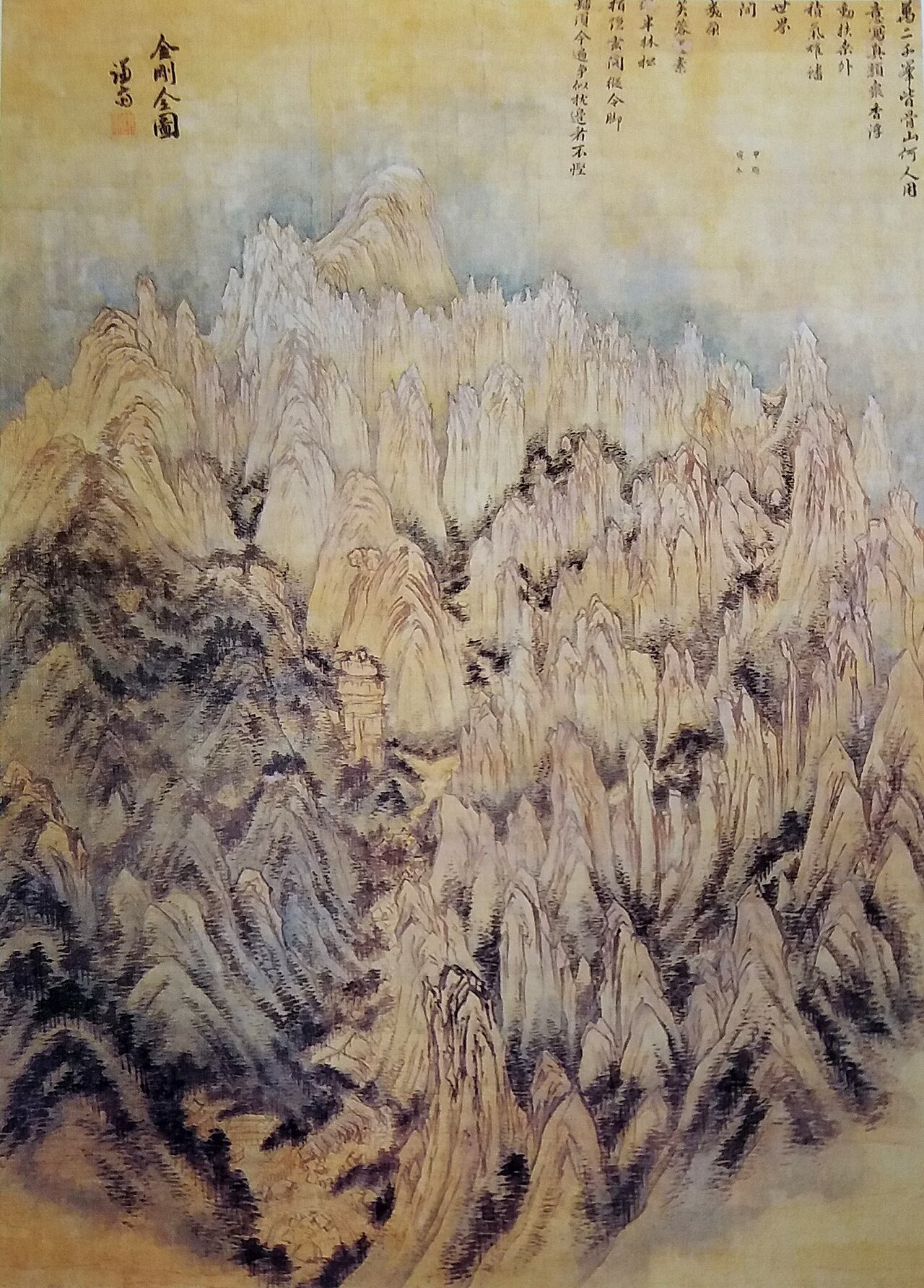
Jeong Seon redirected Joseon landscape from idealized Chinese-style scenery toward jingyeong: true-view paintings of actual Korean places, especially Mount Geumgang and the capital region. He is central to Korean art's claim on local topography.
Life and work
Dates: 1676-1759. Place: Joseon Korea (Seoul and diamond mountains travels). Medium: True-view (jingyeong) landscape painting.
Born in 1676, Jeong Seon (often romanized Chong Son) worked as a painter within Joseon scholarly and official culture. He traveled to famous sites and developed a brush idiom of crystalline peaks and bustling foreground detail. He lived into 1759. Surviving albums and screens sit in Korean museum collections and form a backbone of Joseon painting history. Jeong Seon's true-view project was intellectual as well as visual: Korean places deserved the monumental treatment once reserved for imaginary Chinese peaks. Albums let viewers travel Geumgang on paper when politics or distance blocked the body. Jeong Seon's brush turns granite into facets that catch light like crystal. He packs roads, inns, and tiny travelers into foregrounds so the famous mountain becomes a social geography as well as a sacred massif. Korean museum education still begins many landscape tours with his Geumgang albums.
Signature works
General Jeong Cheodu Viewing the Mountains, albums of Geumgang landscapes, and views of Seoul-area rivers and hills are among the works taught in surveys. Exact title translations vary; the public point is recognizable Korean place made monumental in ink.
Who they inspired
Later Joseon painters and modern Korean artists treating national landscape as subject work in Jeong Seon's shadow. Twentieth-century Korean museum narratives placed jingyeong at the center of a distinct Korean modernity before Western oil painting arrived. Modern Korean painters reclaiming landscape as national subject cite jingyeong as precedent. Tourist photography of Geumgang still unconsciously repeats his crystalline silhouettes.
American / US crossover
Not a US-first story. US audiences meet Jeong Seon through Korean collection galleries (and special exhibitions) at museums such as the Asian Art Museum, LACMA, the Met, and university collections, plus Korean studies programs. He did not work in America. Korean cultural centers in US cities and traveling national-museum exhibitions introduced Jeong Seon to Korean-American students who might never see the albums in Seoul. That diaspora classroom is the honest US note. Including Jeong Seon on the Artists index refuses the habit of telling Korean painting only as a soft echo of China. True-view is an argument about place. American students who meet him through Korean galleries learn that argument without needing a fake US biography.
Era door: Cities, prints, faiths