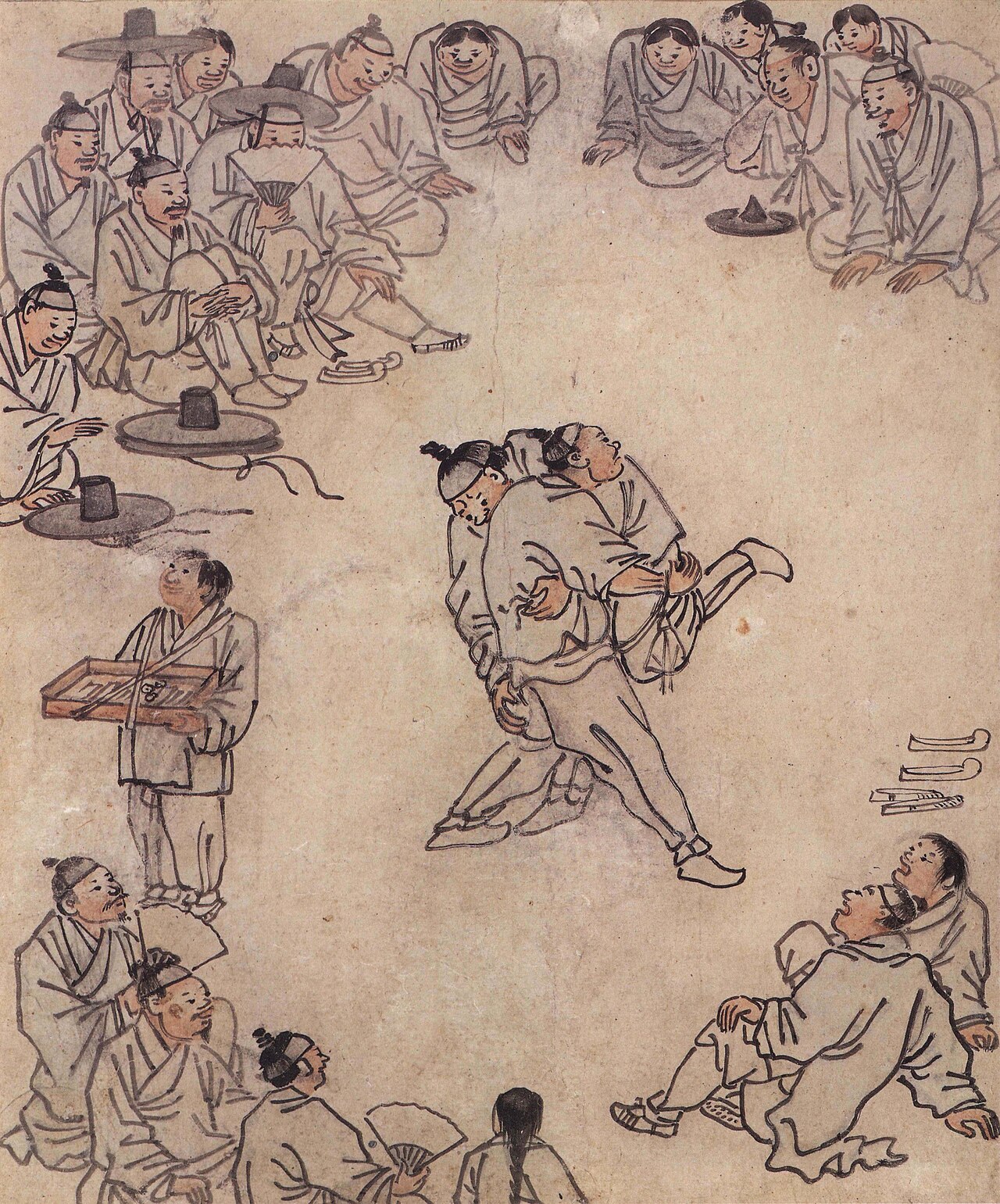
Kim Hong-do, pen name Danwon, is the best-known Joseon genre painter: wrestlers, roofers, schoolrooms, and street life rendered with humor and observational clarity. He also painted landscapes and served in official painting roles.
Life and work
Dates: 1745-c. 1806. Place: Joseon Korea. Medium: Genre painting, landscapes, official painting bureau work.
Born in 1745, Kim Hong-do rose through the Joseon Royal Painting Bureau (Dohwaseo) and worked for court and private patrons. His album of genre scenes became the textbook image of late Joseon daily life. Biographical records note official posts and later financial difficulty; he died around 1806. Scholarship continues to refine attributions within his circle. Working inside the Royal Painting Bureau meant Kim Hong-do could paint both official assignments and sharper genre observations. Humor in his album leaves is documentary without being cruel; laborers and entertainers share dignity with scholars. Look long enough at a Kim Hong-do schoolroom or roof-tiling scene and labor becomes the subject, not scenery. He records tools, postures, and class difference with a reporter's eye tempered by painterly grace. That balance is why later Koreans trusted him as a mirror of Joseon life.
Signature works
The genre album leaves showing wrestling, dancing, washing, and crafts are the public signature. Landscapes and official documentary paintings also survive in Korean collections. Later cataloguers group his genre leaves as windows onto Joseon occupations: smiths, rope makers, ferry passengers, and wrestlers under open sky. Those scenes remain among the most reproduced Korean paintings in classroom packets worldwide.
Who they inspired
Shin Yun-bok and later genre painters share the late Joseon interest in social observation, sometimes with different class and romantic tones. Modern Korean illustration and history education lean on Kim's scenes as visual evidence of period life. History textbooks and museum education kits in Korea lean on his scenes because they feel inhabited. Contemporary manhwa and historical dramas borrow his body language for Joseon everyday life.
American / US crossover
American encounter is museum and textbook based. Korean diaspora communities in the US also sustain interest through cultural centers and traveling exhibitions. No US career is claimed. US Korean studies programs use Kim Hong-do when teaching social history through images. Museum labels in American collections of Korean art often place him beside Shin Yun-bok as the genre pair. Danwon's albums belong in Cities, prints, faiths because they are urban and village social documents as much as brush display. The Collective uses him to teach that unsigned workshop cultures and named painters coexist. Korean-American museum visits are the realistic US door, not an invented residency.
Era door: Cities, prints, faiths