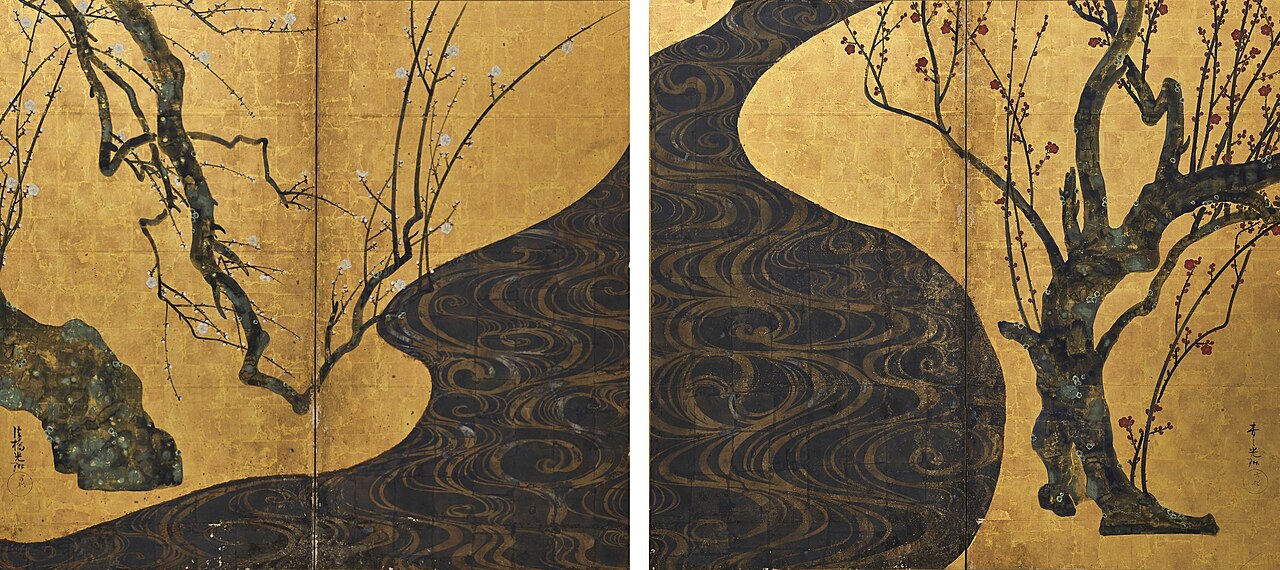
Ogata Korin renewed the decorative brilliance associated with the Sotatsu-Koetsu lineage and gave Rimpa its most famous name. Gold grounds, simplified natural forms, and textile-like pattern made his screens and designs a bridge between painting and craft.
Life and work
Dates: 1658-1716. Place: Kyoto, Japan. Medium: Rimpa painting, lacquer design, screens.
Born in 1658 in Kyoto to a wealthy textile merchant family (Kariganeya), Korin grew up amid luxurious fabrics and design culture. Financial decline pushed him toward professional painting and lacquer. He studied classical Yamato-e themes and the decorative mode associated with Tawaraya Sotatsu. He worked in Kyoto and for periods in Edo. He died in 1716. His brother Ogata Kenzan was a major ceramic artist; their collaboration is part of the Rimpa story. Korin's training among luxury textiles explains why his irises and waves behave like pattern repeats as much as like observed plants. He moved between painting commissions and design for lacquer and related crafts, a fluidity that later museums sometimes separate too neatly into fine art versus decorative art. Korin's screens reward slow looking: repeated iris leaves create rhythm across gold, and the famous plum trees divide a stream with almost abstract force. International loan shows treat these works as ambassadors of Edo design intelligence. Teaching Collective visitors about Korin means teaching that craft knowledge and painting knowledge shared one Kyoto household culture.
Signature works
Publicly famous works include Irises screens (Nezu Museum, Tokyo), Red and White Plum Blossoms (MOA Museum of Art, Atami), and lacquer writing boxes with bold plant motifs. These works are staples of Japanese national-treasure discourse and international exhibitions.
Who they inspired
Korin's name became the school label Rimpa (or Rinpa). Nineteenth- and twentieth-century revivals (Sakai Hoitsu and later modern designers) recycled his floral silhouettes. Western Japonisme collected Rimpa aesthetics as decorative Japan. Contemporary Japanese design and kimono pattern still quote his iris and wave motifs. Twentieth-century Japanese graphic designers and kimono houses returned to Korin whenever they needed bold silhouette without busy shading. Western Art Nouveau and Japonisme designers likewise mined Rimpa for flat botanical drama.
American / US crossover
US museums exhibit and publish Rimpa extensively (Met, Freer, Asian Art Museum San Francisco, and others). The American story is collecting and exhibition history, not a Korin residency. Designers and art students in the US meet him through Japonisme surveys and decorative-arts courses. Major US retrospectives of Rimpa in the late twentieth and early twenty-first centuries cemented Korin's name in American museum education. Collectors met him as design history as much as painting history.
Era door: Cities, prints, faiths