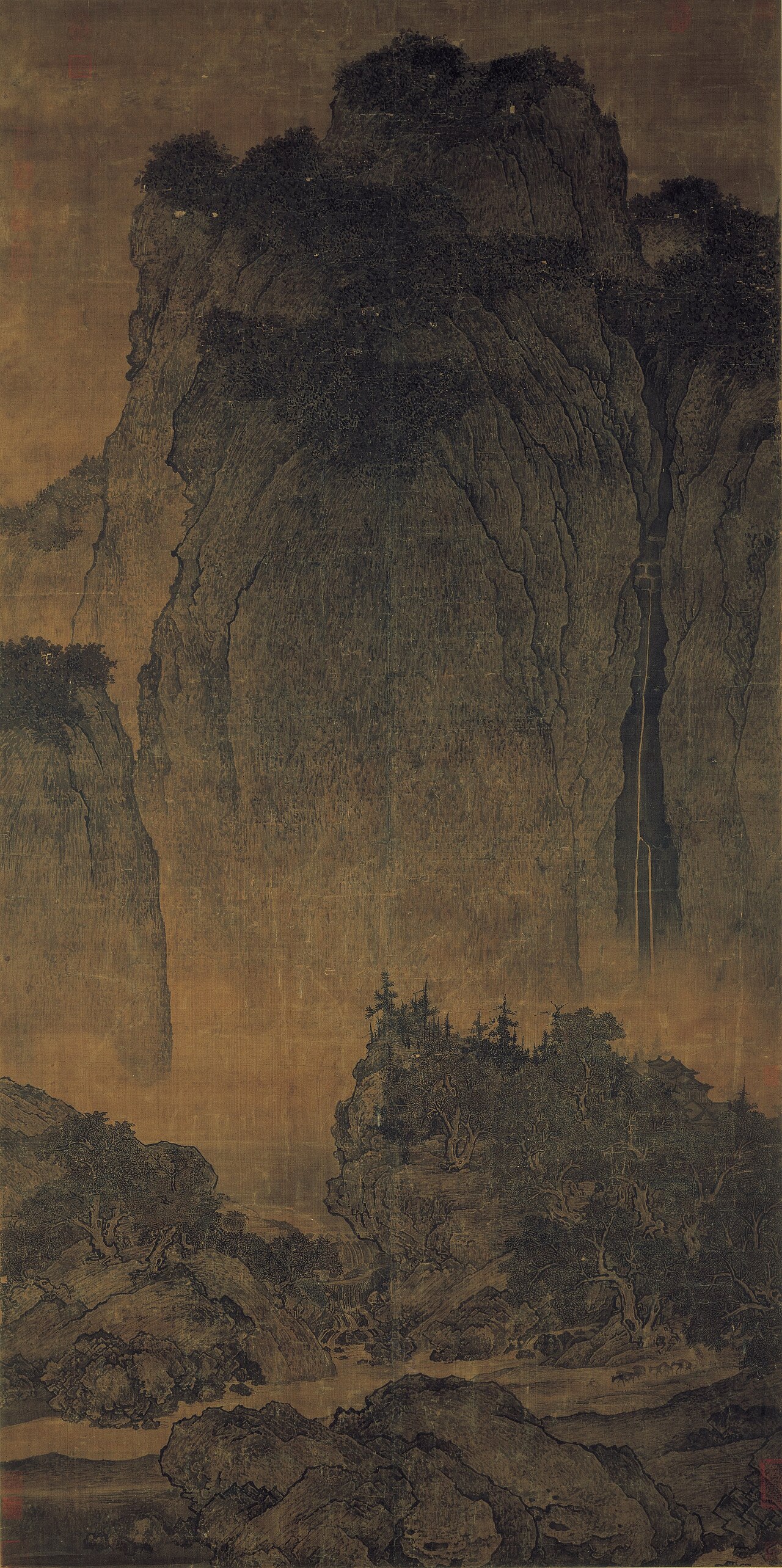
Fan Kuan is the name attached to one of the defining monuments of Chinese landscape painting: Travelers among Mountains and Streams. Northern Song monumental landscape treated mountains as moral and cosmic structure, not as tourist scenery.
Life and work
Dates: c. 960-c. 1030. Place: Northern Song China (active in the north). Medium: Monumental ink landscape painting.
Biographical facts are sparse and filtered through later Chinese painting histories (notably accounts that place him as a recluse who studied nature directly after earlier models). He is generally dated to the late tenth and early eleventh centuries, active in the Northern Song cultural sphere. Precise birth and death years remain approximate. What survives securely in public teaching is the painting tradition and the masterpiece long attributed to him. Chinese painting histories praise Fan Kuan for turning away from soft earlier models toward direct study of mountains. Whether every anecdote is literal matters less for teaching than the surviving pictorial argument: nature's scale disciplines the viewer. Standing before Travelers among Mountains and Streams in reproduction still teaches humility of scale: paths zigzag, trees cling to cliffs, and the peak refuses to become a backdrop. Chinese collectors for centuries used the painting as a touchstone when judging later mountains. The Collective includes Fan Kuan so the Courts and canons door has a named Northern Song anchor without pretending we hold the silk.
Signature works
Travelers among Mountains and Streams (National Palace Museum, Taipei) is the work that carries his fame: a towering central peak, mist bands, and tiny travelers that reset the scale of the human. Later copies and attributions exist; scholarship debates workshop hands, but the painting remains a cornerstone of Chinese art history.
Who they inspired
Northern Song landscape ideals shaped Guo Xi and later literati debates about monumentality versus intimacy. Ming and Qing collectors treated Fan Kuan as an ancestral name. Twentieth-century Chinese art education and museum narratives kept the painting central to classical landscape. Court painters after him competed with that monumentality; literati painters later preferred intimacy but still measured themselves against Song height. Modern ink painters who return to dense texture and towering peaks still invoke the Travelers composition as a silent jury.
American / US crossover
Not a US-first story. American students encounter Fan Kuan through survey textbooks, slides, and occasional international loans or high-quality reproductions. US collections of Song painting are limited compared with Taiwan and China; the crossover is pedagogical and museological reception. When American museums teach Song landscape, Fan Kuan is usually the first name on the slide, even if the actual silk stays in Taipei. That asymmetry is part of the real US crossover story: fame through reproduction and curriculum.
Era door: Courts and canons