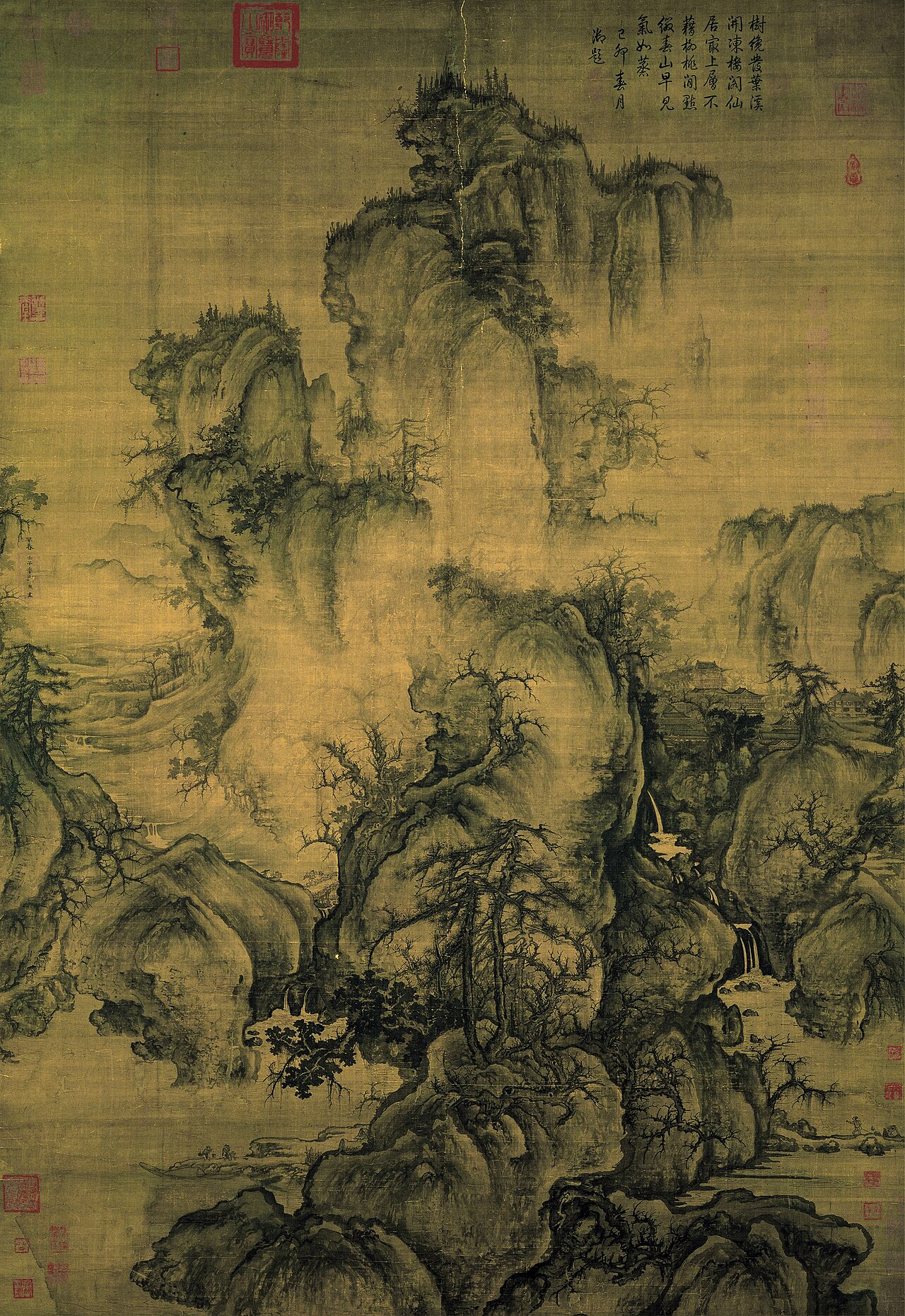
Guo Xi served the Northern Song court and left both a masterpiece landscape and a theoretical text on how to see mountains. Early Spring (dated 1072) is a public landmark of Chinese painting; The Lofty Message of Forest and Streams articulates seasonal and atmospheric seeing.
Life and work
Dates: c. 1020-c. 1090. Place: Northern Song court, Kaifeng sphere. Medium: Ink landscape painting; painting theory.
Active at the Northern Song court in the eleventh century, Guo Xi worked under imperial patronage and became a leading landscape master of his generation. His son Guo Si helped preserve and transmit his father's writings and reputation. Exact personal biography beyond court service is thinner than the documentary trail of the painting and treatise. Court service meant Guo Xi painted for imperial spaces where landscape also signaled good governance and cosmic order. The survival of a dated masterpiece plus a transmitted treatise makes him unusually teachable among early masters whose biographies otherwise blur. Reading Guo Xi's ideas beside the painting shows how theory and practice reinforced court taste. He describes mountains as if they were living bodies with breath and pulse. That metaphor traveled into later Chinese aesthetics and into modern classrooms that still ask students to name atmospheric depth band by band.
Signature works
Early Spring (National Palace Museum, Taipei) shows a complex, rotating mountain world with travelers and temples embedded in mist. The associated painting text discusses angles of viewing, seasonal moods, and the idea that landscape should be livable for the eye. These are standard references in Chinese art history.
Who they inspired
Guo Xi influenced court and professional landscape painters and later literati who argued with or absorbed Northern Song monumentality. His treatise entered the toolkit of Chinese painting education. Modern Chinese ink painters still cite Song landscape as a measure. Later painters cited his seasonal modes and shifting vantage points. Art schools in modern China assigned Early Spring as a structural lesson in how mist bands create depth without Renaissance perspective lines.
American / US crossover
Like Fan Kuan, Guo Xi reaches US audiences mainly through art-history teaching, publications, and rare loan exhibitions. He did not have an American career. Honest crossover language stops at museums and classrooms. US graduate seminars in Chinese painting routinely pair Guo Xi's treatise excerpts with the Taipei painting. The American relationship is scholarly and curatorial, not a personal US biography. The Collective keeps Guo Xi beside Fan Kuan so Northern Song landscape reads as a conversation, not a single peak. Early Spring rewards patience: temples appear, then vanish into vapor. US crossover stays honest: classroom and rare loan, never a fictional American workshop.
Era door: Courts and canons