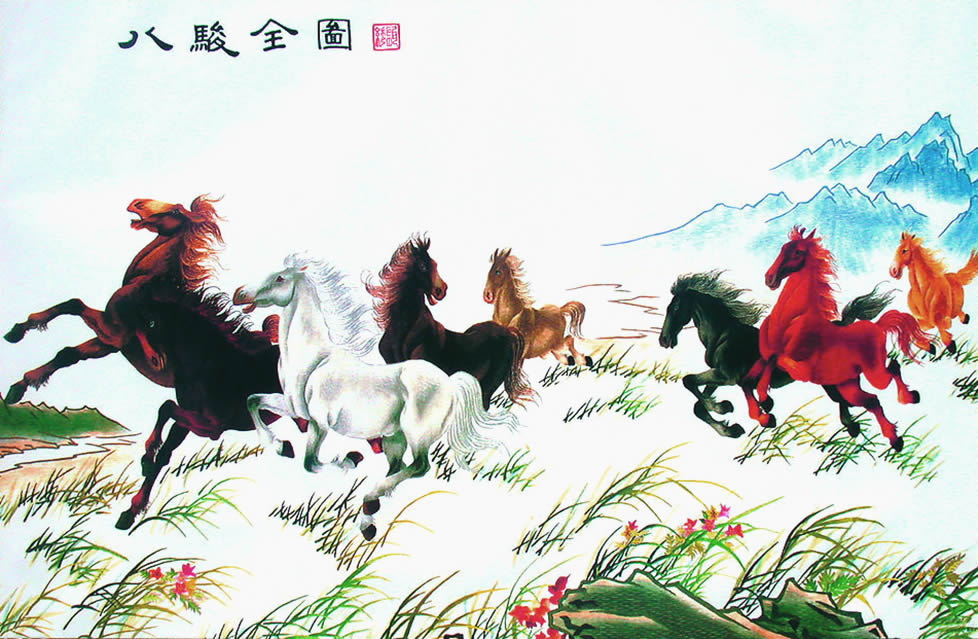
Xu Beihong argued that modern Chinese painting needed rigorous figure draftsmanship drawn from academic study abroad, while still painting Chinese subjects. His ink horses became national icons; his career sits at the hinge of Republican-era art schools and cultural politics.
Life and work
Dates: 1895-1953. Place: Jiangsu origin; studied in Tokyo and Paris; major career in China. Medium: Oil and ink; horses, historical subjects, academic realism.
Born in 1895 in Yixing, Jiangsu, Xu studied in Tokyo and then in Paris (Ecole Nationale Superieure des Beaux-Arts circles and academic training). He returned to China to teach and to lead art institutions, including roles connected with National Central University and later the Central Academy of Fine Arts in Beijing. He died in 1953. His public role in art education is documented in standard biographies. Xu's dual practice in oil and ink made him a symbol of choice for Republican cultural reformers who wanted technical strength without abandoning Chinese subject matter. Teaching posts mattered as much as individual canvases: he shaped what count as serious training. Xu's horses are not only animals; they became metaphors of spirit and national striving in public speech. His figure paintings of historical Chinese subjects tried to prove that academic anatomy could serve local narrative. Whether one agrees with his program or not, the cracked-mirror era is incomplete without his name.
Signature works
Famous public themes include galloping ink horses, the oil painting Tian Heng and His Five Hundred Followers, and other historical or allegorical canvases used in teaching Chinese modern art. Museum collections in China hold core works; international exhibitions have shown loans.
Who they inspired
Xu influenced academic art education in China and painters who combined ink wash with anatomical modeling. Debates for and against his Westernizing program shaped twentieth-century Chinese art criticism. Horse imagery after Xu became a shared patriotic and decorative vocabulary. Generations of academy students inherited his horse as both studio exercise and patriotic emblem. Critics who rejected his program still had to argue against it, which is another form of influence.
American / US crossover
Xu's Paris training ties him to European academic networks. American museums occasionally show or publish his work in modern Chinese art surveys. He is not a US-career artist; honest crossover notes international study and later global exhibition, not an American home base. American audiences meet Xu mainly in survey shows of modern Chinese art and in academic writing comparing Chinese realism debates to Mexican muralism or Soviet academicism. The link is comparative modernism, not a long US studio chapter.
Era door: The cracked mirror